You’ve probably heard about Carl Jung at one point or another. Swiss psychiatrist born in 1875, former pupil turned collaborator to Sigmund Freud, he became one of the most important figures in the history of modern psychology after he founded analytical psychology. Jung also contributed with ideas and concepts such as, one of my favorites, the collective unconscious, and most notably: the archetypes.
Table Of Contents:
- What Are The 12 Brand Archetypes?
- 4 Cardinal Orientations or Motivational Drives
- How Choosing An Archetype Can Position Your Brand
- Keys To Successful Brand Archetype Shifts
- 12 Archetypes In Personal Branding & Communication
- Choose Your Archetype To Differentiate Yourself When Communicating
- Best Brand Archetype Combinations
- Let’s Wrap It Up
Carl Jung didn’t create the “brand archetypes” as we know them today, but he did lay the foundations to what they are and mean. Initially, Jung said that archetypes are limitless, patterns emerging from the beautiful concept of collective unconscious. Some of these archetypes are the:
- The Self
- The Shadow
- The Anima
- The Animus
- The Persona
Based on Jung’s work, Carol Pearson invented the 12 brand archetypes we use nowadays (it’s an amazing read, so go read about it!). They are commonly referred as either the “12 brand archetypes” or the “12 Jungian archetypes”. I’m not here to choose what’s the best or right way to name them, I just explain which is which, and why the names. From now on, we’ll refer to them as the “Brand Archetypes”, which were influenced by Carl Jung’s archetypes.
What will we cover in this long article? We will go over the brand archetypes and show you a framework on how to use them for your personal brand and communication. Before we get there, we need to give more context, so we’ll go over the archetypes and how they have influenced communication and storytelling to the point they are now a huge influence in marketing, branding, storytelling, speeches, show personalities and pretty much any form of communication.
Personally, I’ve been massively influenced by these archetypes to the point that I’ve experimented in using one or another as a “mask” or “character” in different scenarios, from speeches to social dynamics. Yeah, it might sound as a bit weird to you, but the goal behind it was to experiment and understand how they can shape communication in general, and how I could then apply that for marketing and communication purposes.
What Are The 12 Brand Archetypes?
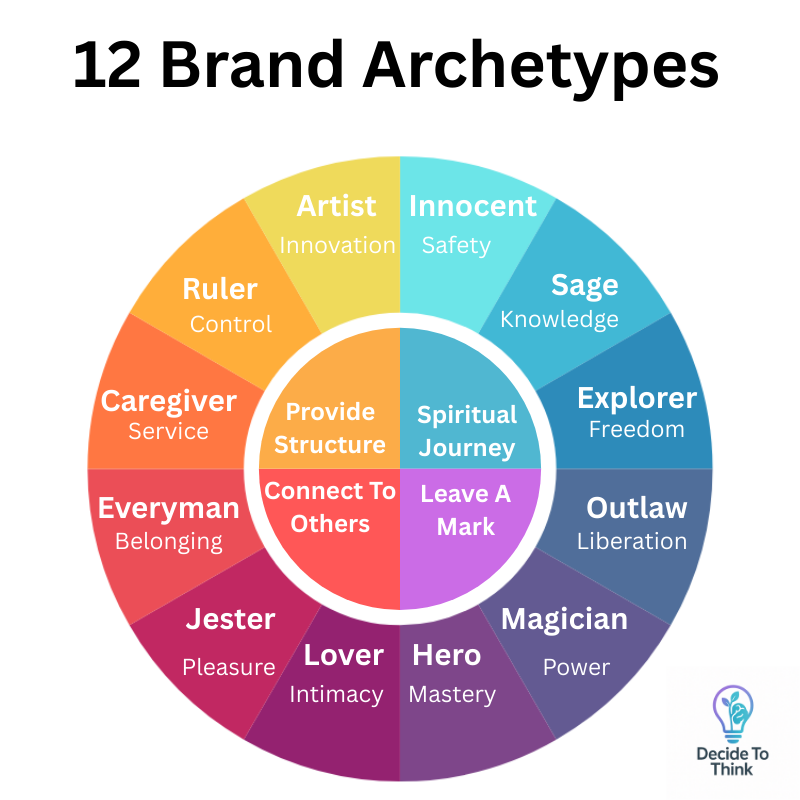
Let’s begin by simply listing the 12 brand archetypes, then we’ll go more in depth into what each one means.
- The Innocent
- The Everyman
- The Hero (Warrior)
- The Caregiver
- The Explorer
- The Rebel (Outlaw)
- The Lover
- The Creator (Artist)
- The Jester
- The Sage
- The Magician
- The Ruler
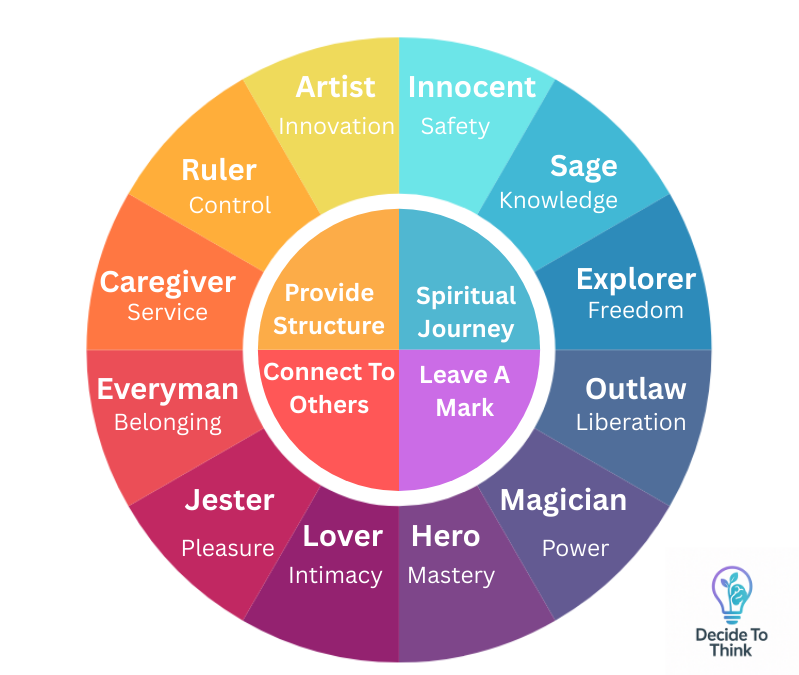
This wheel is what we call the “Brand Archetype Wheel”, which you might have seen somewhere, read about or heard about when it comes to marketing and branding.
I will explain the inner circle further down, for now let’s take a look at each of the 12 brand archetypes.
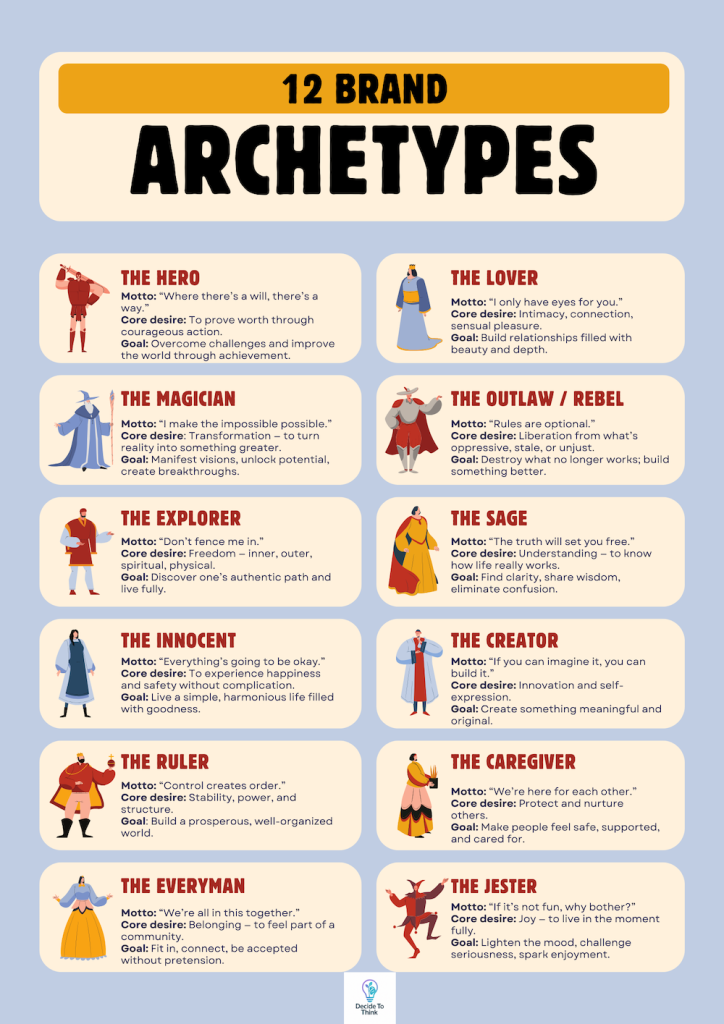
The Innocent
- Motto: “Everything’s going to be okay.”
- Core desire: To experience happiness and safety without complication.
- Goal: Live a simple, harmonious life filled with goodness.
- Greatest fear: Corruption, disappointment, or being punished for doing wrong.
- Strategy: Do the right thing, follow the rules, stay optimistic.
- Weakness: Naivety, avoidance of unpleasant realities.
- Talent: Unshakable optimism and the ability to uplift others.
- Branding Application: Evokes trust and simplicity. Ideal for brands promising uncomplicated experiences or a return to basic goodness (e.g., natural products, wholesome food, or sentimental childhood brands). Focus is on optimism and virtue.
- Brand Example: Coca Cola, focuses on happiness and nostalgia.
- Communication Style: Communicates sincerity and unwavering optimism. Positions you as a trusted, non-threatening source of advice or knowledge, focusing on ethical and transparent communication. Your message is often one of hopeful possibility and straightforward honesty.
The Sage
- Motto: “The truth will set you free.”
- Core desire: Understanding, to know how life really works.
- Goal: Find clarity, share wisdom, eliminate confusion.
- Greatest fear: Being misled, ignorant, or intellectually powerless.
- Strategy: Research, analyze, question everything, think deeply.
- Weakness: Overthinking, analysis paralysis, emotional detachment.
- Talent: Insight, clarity, and the rare ability to make the complex feel simple.
- Branding Application: Positions a brand as the expert, mentor, or thought leader. Ideal for consulting, education, research,
- and high-complexity tech sectors. Branding utilizes data, intellectual rigor, and objective analysis to establish credibility.
- Brand Example: The New York Times, truth, clarity.
- Communication Style: Adopts a highly analytical and authoritative communication style. You become the go-to person for complex, evidence-based insights. Focus on articulating complex concepts clearly and prioritizing informed dialogue over quick fixes.
The Explorer
- Motto: “Don’t fence me in.”
- Core desire: Freedom, inner, outer, spiritual, physical.
- Goal: Discover one’s authentic path and live fully.
- Greatest fear: Conformity, stagnation, boredom.
- Strategy: Seek experiences, roam widely, reinvent often.
- Weakness: Restlessness, commitment issues, perpetual dissatisfaction.
- Talent: Adaptability, innovation, and the courage to pursue possibility.
- Branding Application: Appeals to those who feel constrained. Excellent for travel, outdoor gear, off-road vehicles, or non-conformist apparel. The brand promises a liberating, pioneering experience or a path to self-discovery, emphasizing rugged independence.
- Brand Example: The North Face or Red Bull “It Gives You Wings”.
- Communication Style: Communicates a sense of unconventional expertise and boundary-pushing thought. You are the pioneer in your field, always seeking new methods or markets. Your narrative involves personal evolution and the courage to stand apart from the status quo.
The Outlaw (Rebel)
- Motto: “Rules are optional.”
- Core desire: Liberation from what’s oppressive, stale, or unjust.
- Goal: Destroy what no longer works; build something better.
- Greatest fear: Powerlessness, being silenced, forced conformity.
- Strategy: Disrupt, shock, protest, break patterns boldly.
- Weakness: Self-destruction, alienation, chaos without a plan.
- Talent: Revolutionary vision and the fire to create real change.
- Branding Application: Excellent for counter-cultural products, shock marketing, or disruptive technology. The brand challenges the dominant industry narrative, appealing to consumers who feel marginalized or want to exert non-conformity. Focus is on radical liberation.
- Brand Example: Harley-Davidson.
- Communication Style: Positions you as a provocative disruptor or a contrarian expert. Your communication is often bold, unapologetic, and targeted at dismantling established norms. Use a confident, challenging tone to galvanize followers into adopting a new system or perspective.
The Magician
- Motto: “I make the impossible possible.”
- Core desire: Transformation, to turn reality into something greater.
- Goal: Manifest visions, unlock potential, create breakthroughs.
- Greatest fear: Negative consequences of their own power; failure of the “spell.”
- Strategy: Use intuition, insight, systems, and unexpected methods.
- Weakness: Illusion, manipulation, over-promising.
- Talent: The ability to reveal new possibilities and spark awe.
- Branding Application: Associated with visionary technology, entertainment, or products that facilitate dramatic, seemingly effortless transformation (e.g., cosmetic lines, software that solves a major complexity). Focuses on experience and mastery.
- Brand Example: Disney, fantasy and transformation.
- Communication Style: Conveys a sense of visionary capability and effortless execution. You communicate a “before-and-after” narrative, showcasing your ability to intuit complex problems and apply highly effective, proprietary methodologies for rapid results.
The Hero
- Motto: “Where there’s a will, there’s a way.”
- Core desire: To prove worth through courageous action.
- Goal: Overcome challenges and improve the world through achievement.
- Greatest fear: Weakness, failure, incompetence.
- Strategy: Train, compete, endure; rise to every challenge.
- Weakness: Arrogance, burnout, inability to accept help.
- Talent: Strength, resilience, and the capacity to inspire others to greatness.
- Branding Application: Ideal for performance-oriented products, sportswear, insurance, or services that help people overcome major obstacles. The brand promises to empower the consumer to be their strongest, most capable self.
- Brand Example: Nike, “Just Do It”.
- Communication Style: Emphasizes resilience, commitment, and competitive drive. Your communication showcases past “battles” won and highlights your tenacity in achieving difficult objectives. Adopt a direct, empowering, and action-oriented tone.
The Lover
- Motto: “I only have eyes for you.”
- Core desire: Intimacy, connection, sensual pleasure.
- Goal: Build relationships filled with beauty and depth.
- Greatest fear: Rejection, disconnection, being unlovable.
- Strategy: Become emotionally expressive, attractive, attentive.
- Weakness: Overattachment, jealousy, losing oneself in others.
- Talent: Passion, devotion, and the ability to create profound emotional bonds.
- Branding Application: Used for luxury goods, fine dining, perfume, jewelry, and brands that emphasize beauty, passion, and sensory indulgence. Focus is on creating a deep, emotional bond and exclusivity.
- Brand Example: Victoria’s Secret, seduction, intimacy, glamour.
- Communication Style: Communicates through elegant, high-touch, and personalized engagement. Your focus is on fostering deep, loyal relationships and appealing to a sophisticated sensibility. The tone is often alluring, warm, and highly appreciative of quality and detail.
The Jester
- Motto: “If it’s not fun, why bother?”
- Core desire: Joy — to live in the moment fully.
- Goal: Lighten the mood, challenge seriousness, spark enjoyment.
- Greatest fear: Being boring, irrelevant, or ignored.
- Strategy: Humor, play, spontaneity, clever irreverence.
- Weakness: Avoids seriousness, deflects with jokes, lacks focus.
- Talent: Quick wit, emotional disarmament, and making life feel lighter.
- Branding Application: Excellent for entertainment, snacks, alcohol, or any brand that aims to dispel boredom and foster a sense of community. Uses humor, wordplay, and a lack of seriousness to be memorable and approachable.
- Brand Example: Old Spice, comedy in each ad.
- Communication Style: Your communication is highly engaging, witty, and unpredictable. You use humor to disarm difficult topics and connect with audiences on a purely human level, making complex ideas immediately accessible and fun. You are the charismatic conversationalist.
The Caregiver
- Motto: “We’re here for each other.”
- Core desire: Protect and nurture others.
- Goal: Make people feel safe, supported, and cared for.
- Greatest fear: Harm coming to anyone they care about — or being seen as selfish.
- Strategy: Serve, support, comfort, give generously.
- Weakness: Burnout, enabling, neglecting their own needs.
- Talent: Compassion, patience, and an instinctive ability to heal.
- Branding Application: Common in healthcare, insurance, non-profits, and service industries that promise safety, support, and reliability. The brand’s messaging emphasizes empathy, generosity, and trust.
- Brand Example: UNICEF, quite obvious, offers humanitarian care.
- Communication Style: Establishes you as a nurturing, reliable, and supportive figure. Your communication prioritizes the audience’s well-being and growth. Focus on clear, patient guidance and demonstrating genuine concern for your community or clients.
The Creator
- Motto: “If you can imagine it, you can build it.”
- Core desire: Innovation and self-expression.
- Goal: Create something meaningful and original.
- Greatest fear: Mediocrity, dullness, uninspired work.
- Strategy: Experiment, design, imagine, refine — endlessly.
- Weakness: Perfectionism, impracticality, emotional volatility.
- Talent: Vision, originality, craftsmanship, and aesthetic mastery.
- Branding Application: Ideal for design-centric products, art supplies, software, and marketing/PR agencies. The brand is positioned as a catalyst for creativity and the development of unique, high-quality solutions.
- Brand Example: LEGO, you can build anything.
- Communication Style: Communicates through original thought, innovative processes, and exceptional craft. You position yourself as a master builder or conceptual artist. Your narrative highlights your unique methodologies and the tangible, aesthetically valuable results you produce.
The Ruler
- Motto: “Control creates order.”
- Core desire: Stability, power, and structure.
- Goal: Build a prosperous, well-organized world.
- Greatest fear: Chaos, instability, being overthrown.
- Strategy: Lead firmly, set rules, enforce systems.
- Weakness: Rigidity, authoritarian tendencies, elitism.
- Talent: Leadership, responsibility, and the ability to create lasting order.
- Branding Application: Dominant in luxury, high-end finance, high-performance automobiles, and IT security. The brand promises premium quality, stability, and exclusivity. Messaging is confident, authoritative, and sophisticated.
- Brand Example: Rolex, status.
- Communication Style: Adopts a highly polished, executive, and decisive communication style. You project competence and unwavering confidence, establishing yourself as the definitive authority who dictates best practices and guarantees reliable outcomes.
The Everyman (Orphan/Realist)
- Motto: “We’re all in this together.”
- Core desire: Belonging, to feel part of a community.
- Goal: Fit in, connect, be accepted without pretension.
- Greatest fear: Exclusion, alienation, standing out in the wrong way.
- Strategy: Be relatable, modest, friendly; find common ground.
- Weakness: Can blend in too much, lack distinction, avoid ambition.
Talent: Practicality, authenticity, and the ability to unify people. - Branding Application: Excellent for mainstream consumer goods, staple foods, and community-focused services. The brand is down-to-earth, affordable, and trustworthy, emphasizing reliability and a common-sense approach over flash.
- Brand Example: Levi’s, timeless.
- Communication Style: Communicates with approachability, transparency, and relatability. You strip away jargon and pretension, building trust by being genuine and humble.16 You are the trusted colleague whose insights are practical, well-tested, and universally applicable.
4 Cardinal Orientations or Motivational Drives
As promised, the inner part of the wheel shown above, the core. These four groups are often referred to as the Cardinal Orientations or Core Motivational Drives. Each group contains three archetypes that share the same fundamental goal: creating a dynamic system of identity, function, and purpose.
1. Ego-Driven Archetypes: The Quest for Independence and Fulfillment
Primary Goal: To establish and maintain a strong, capable identity and mastery over the physical world. These archetypes focus on skill acquisition, courage, and self-efficacy.
Cardinal Orientation: Self-Definition and Mastery.
The Archetypes:
- The Innocent: Seeks independence through purity and unwavering optimism, defining self through virtue.
- The Explorer: Seeks independence through autonomy and continuous discovery, defining self through the journey.
- The Sage: Seeks independence through intellect and competence, defining self through knowledge and truth.
Branding Strategy: Brands in this quadrant promise to empower the customer to achieve a state of excellence, expertise, or personal fulfillment, allowing them to better navigate their environment.
2. Soul-Driven Archetypes: The Quest for Change and Risk
Primary Goal: To challenge the status quo, transform reality, and push beyond existing limitations. These archetypes focus on risk-taking, vision, and dynamic action.
Cardinal Orientation: Risk and Transformation.
The Archetypes:
- The Outlaw (Rebel): Drives transformation through disruption and radical change, often breaking established norms.
- The Magician: Drives transformation through vision and mastery of the unknown, creating extraordinary realities.
- The Hero: Drives transformation through courage and decisive action, overcoming great systemic obstacles.
Branding Strategy: This quadrant applies to brands that promise a fundamental, revolutionary change in the customer’s life or industry. Their messaging is active, ambitious, and focuses on breaking barriers.
3. Self-Driven Archetypes: The Quest for Order and Structure
Primary Goal: To provide structure, stability, and enduring value to the world. These archetypes are focused on leaving a lasting legacy, generating excellence, and maintaining control.
Cardinal Orientation: Stability and Control.
The Archetypes:
- The Creator: Establishes order through innovation and creation, giving form to ideas that endure.
- The Ruler: Establishes order through authority and leadership, maintaining structure and stability.
- The Caregiver: Establishes order through service and altruism, protecting and stabilizing others’ well-being.
Branding Strategy: Brands here are typically premium, dependable, or highly essential. They assure the customer of long-term quality, safety, and a reliable structure that manages chaos or complexity.
4. Social-Driven Archetypes: The Quest for Belonging and Connection
Primary Goal: To foster connection, intimacy, pleasure, and community among individuals. These archetypes focus on relationships and human experience.
Cardinal Orientation: Belonging and Enjoyment.
The Archetypes:
- The Everyman: Finds belonging through realism and acceptance, relating authentically to the common person.
- The Jester: Finds belonging through joy and shared pleasure, using humor to connect and disarm.
- The Lover: Finds belonging through intimacy and attraction, creating deep, sensual bonds.
Branding Strategy: These brands promise an enriching social experience or a feeling of deep acceptance and community. Their marketing is often warm, approachable, and focused on shared human moments.
How Choosing An Archetype Can Position Your Brand
By this point you’ve read all the theory, boring or not, it’s important, it created the groundworks for what comes next: how you can choose an archetype to position your brand from a marketing perspective.
Further down, we’ll explore it even more in depth: using the archetypes in personal branding and communication.
From a marketing perspective, you first need to understand where your brand currently stands.
I’ll give you an example of how I worked with a company I built: Guana Equipment. My business partner knew the camping and overlanding industry inside out, as we had worked in it for quite a few years. We understood quite well the position other brands had, and we knew we wanted the brand to identify with ourselves: fearless and adventurous, and at the same time with a strong bond to our roots.
Guana Equipment was immediately positioned as a brand that would be based mainly in the Explorer archetype, with shades of Hero and Everyman.
Our tents were made for those who searched restlessly for freedom, who wanted to explore the corners of the Earth, live an adventure, but at the same time, do it by breaking barriers, challenging the norm, and wanted to be a part of a great community.
In the first place, our brand was easily identifiable in our products: a tent to explore. We connected through a quest for spirituality, fulfillment. If you went a bit deeper into what we represented, we mentioned how as a brand, we aimed to push limits, we wanted a better product to be able to give you comfort in courage: go further, we’re backing you. Finally, if you really connected with the brand and wanted to know more about us, we told you our story: a Costa Rican brand that was thought, designed and tested for campers and explorers in one of the most wild and adventurous countries in the planet. And we weren’t scared to go global. If you wanted to be a part of our family, you could join.
Now, that’s how you do some of the thought process behind the brand. But what if you’re already working with a brand and need to market it? What if the brand itself already has an archetype or archetypes that represent them? Can you change that?
Yes. Yes, you can.
You can change a brand’s archetype to stay relevant, evolve with new trends or chains of thought, and to show the customers and the world that you can grow to meet their needs.
Is that dangerous? It can be if done the wrong way, as it can alienate loyal customers, even anger them or piss them off. That’s why it must be done properly.
The good news is that marketing is now deeply connected to storytelling, and as you tell a story you go through the classic Hero’s Journey, where you face an adventure, learn a lesson, fight an antagonist, and then win.
If done properly, you can create a marketing campaign where your brand, that belongs to a few archetypes, can shift into new ones as it goes through a journey.
Take Bud Light as an example, they went from being positioned as the Jester (“Famous Among Friends”) and Everyman, into the Outlaw and Explorer with the Dylan Mulvaney marketing campaign.
This is a great example of how not to do the shift. Anheuser-Busch, parent company of Bud Light, made a big mistake, which was completely alienating a very loyal customer base, and making a very dramatic shift from one very solid archetype foundation, into a completely different one.
From conservative, to disruptive, with no explanation or middle ground.
Would the shift have been a successful if they went more slowly? Probably not. They could’ve still managed to acquire a larger customer base without upsetting their loyal customers, by making a more gradual shift, perhaps going for the Hero and connecting with courageous people in other fields, such as hard workers looking for a well-deserved beer at the end of a shift.
That said, let’s look at Apple, as they had a successful transformation. Back in the day, Apple was the Outlaw, rebelling against IBM. As they developed new products, innovated with their computers, they shifted into the Artist, innovating, and the Magician, leaving a mark with their vision of new and endless possibilities. That’s a gradual and smart shift.
Keys To Successful Brand Archetype Shifts
If you want to shift, transform or evolve from one archetype to another, you should follow these steps.
Clear Strategy: You shouldn’t just follow a trend, as trends can extinguish quickly, or be fool’s gold. Instead, analyze the trend, how it connects or affects with your brand or company, map your customer base, and design a strategy that’s rooted in both of your customer’s and your brand’s values.
Are your values, mission and vision rooted in loyalty, then stay loyal but you can also build a narrative around being a Hero or a Caregiver.
Evaluate The Evolution: Gradual Or Drastic? Historically, we’ve seen both strategies work. A sudden drastic change is disruptive and leads to a lot of attention. Who remembers Miley Cyrus going from a nice Disney girl to a fearless and disruptive pop icon? Well, it worked well for her, even if she lost many fans, she wanted to be seen as a woman pop star, not as a cute child actress.
We’ve also seen gradual evolutions have. A lot of success. Again, that depends on your values, customer base, and what you know deep inside you are as a brand.
Be Consistent: Again, let’s take Miley Cyrus, she was consistent with her change. She disrupted the music industry with provocative music videos and music. If you’re going to make a shift, be consistent with the ads, marketing, tone, voice and communication.
Align As A Company: Are you making the change? Everyone must be aligned and on board. The entire company. Period.
Be Transparent: Perhaps one of the most important ones is being transparent with your customers and audience. Tell them why you’re making the change. Is it due to a trend? Is there something new you are developing? Has something happened to lead to a change? Tell them, they need to be in the loop to feel connected to your transformation.
12 Archetypes In Personal Branding & Communication
How can an archetype shape my personal brand or the way I communicate?
Nowadays we are living in the era of personal branding. Your social media channels are flooded with coaches, experts, people selling courses, influencers, you name it. Everyone is selling themselves.
Does that mean they’re like that in real life? Probably not, maybe a bit, not entirely. They need to build a personal brand with some specific traits that can help them stand out or excel or relate to others in their field.
If I’m a nuclear physicist, maybe I’m funny, witty, and in my personal life I feel more like the Jester, but if I want to be invited to give lectures, or be a professor at a university, or land a job, I might prefer to show myself as the Artist/Creator or the Sage.
You get the point.
Personal branding works in a very similar way as branding in general. The difference is, you’re not advertising, or doing a marketing strategy for an “abstract entity” like a company. You are doing it for yourself. That means that at times, you might feel phony, fake, or be embarrassed. Right?
You might feel that daily, with your friends and family, your true self is a blend of one or two different archetypes. So, why would I sell myself as something else? Something I’m not?
Well, that’s where you either are consistent and stick to yourself (but remember, brands need to evolve, and so eventually you will have to do it too), or you differentiate between your private true self, and the personal brand you’re building.
The good news is, as humans we are allowed to change, evolve, shift, and honestly, wear different masks. Have you ever heard of the “Masking Theory” or the book called “The Presentation Of Self In Everyday Life” by Erving Goffman?
If you haven’t, in a nutshell, Goffman explains how humans wear imaginary masks in different social scenarios or interactions. We change, adapt or dress up our personality depending on the context surrounding us. We want to be seen in one way or another. Therefore, we are in a way constantly shifting archetypes as humans. We shift between our “Persona” (the mask we wear in public) and our “True Self”.

Haven’t you ever been the Innocent with your parents or grandparents, and turned into the Outlaw with your friends? And haven’t you been scared of showing the Outlaw to your grandparents as they don’t know that “side” of you, and a drastic change could worry them? Therefore, if you choose to show them, you do so gradually.
Ok, again, you get the point.
As said, the good news is that if you know how to separate your everyday life from work, you’ll understand you can adopt an archetype for personal branding.
The question now is, how do you choose one or the other? Here’s where we come to the end of this journey.
Choose Your Archetype To Differentiate Yourself When Communicating
How to choose your archetype when communicating? Or when defining a personal brand? Or your “online persona”? Or your “public persona”?
The 12 brand archetypes can be used in pretty much any situation you’re in. Just like we consciously and unconsciously wear “masks” depending on our social context, gathering or interaction, we can utilize archetypes as the masks.
Suddenly, you might find yourself having to give a work presentation in front of clients or a large group, and you decide that you’ll play the Jester and the Everyman, delivering some fun, yet giving a powerful sense of belonging.
Maybe you’re looking to give a pitch to an important person, you need to find ways to deliver your message, so it leaves a mark, yet you don’t want to come in as arrogant. Therefore, you choose to play the Magician mixed with the Caregiver.
You get it, now here comes “the meaty” part: the framework.
Defining your archetype in personal branding and communication is not that hard.
Here are the steps:
- Understand The 12 Brand Archetypes: what each one stands for, and how they behave.
- Identify Your Core Goal: What are you looking to do? What need or problem are you trying to solve? Do you want to inspire others to become entrepreneurs? Or are you planning to grow in the company you work in? Or say you want to become a more extroverted person. A clear goal is key.
- Define Your Values: What defines you as a person, brand, or character? Sure, the goal is a part of that. But what are you deep down? Not your mission, nor your vision, but your values aligned to those goals. You want to inspire? Great. What gives you depth as a character? Perhaps is honesty. You inspire entrepreneurship by showing proof of what you have achieved, with honesty. You want to be funny, but without offending anyone.
- Analyze Your Peers/Competition: What are other people in your field doing? Look at them, understand what their archetypes are, how they position themselves and if they’re successful or not. After you understand the field you’ll be playing in, can you position yourself differently? Does a specific archetype seem a good fit in the industry or not? Does it align with you?
- Choose Your Primary Archetype: If you wanted to inspire entrepreneurship, you could be the Hero, or the Explorer. If you wanted to grow in the company, you could be the Sage or the Artist. If you just want to be a more extroverted person, you can adopt the Jester. Choose an archetype based on your goals and values. You get it.
- Choose 1 or 2 Supporting Archetypes: Blend them together (we have a section below about this), to add depth to your character, to your brand or message. Remember, you need to show adaptability, the capabilities to evolve, shift, and be more than just one thing.
- Be Coherent: The choice of archetypes must be coherent. You can’t be a Jester with a shade of Magician, and then one day turn into Innocent or Ruler. Just like a brand would, the character you’re choosing, the message you’re communicating, must be coherent.
- Be Consistent: Your messages, your videos, your blogs, your words and actions must be consistent with the role you chose to play. If you’re going to talk to an audience, the entire speech must remain in the archetypes you chose. If you’re not playing the Jester, at all, but the Sage, then you can’t just break character superficially. You need to remain consistent, as a brand would, as a company would, with your goals and values! Remember, you identified both at the beginning!
This is the framework you need to follow in order to be a great communicator, or sell your personal brand.
Remember, we all always wear masks. You are allowed to shift, change, evolve, wear masks. Communication in its core is marketing. All forms of expression have a goal, whether it’s persuading, seducing, convincing, collaborating, helping, or looking for an answer. Expressing something is very rarely neutral. Forms of expression also change depending on the context we’re in.
Therefore, understanding communication means we understand that “marketing ourselves” is a part of it. Choosing the archetypes is a strategy to communicate or express ourselves in a better and more strategic way.
Now, let’s finalize it with understanding the best archetype blends.
Best Brand Archetype Combinations
Hero + Magician:
This is like the “revival immune shot” you take at the gym, it will blow you away. Think Nike and Stripe: heroic determination with a sprinkle of wizard-level transformation.
Creator + Ruler:
Innovation meets authority. This duo says, “I’ve invented the new standard, you’re welcome.” For example, Apple and Tesla, casually redesigning the future while the rest of us are still updating our software. Just one thing, if you adopt these two as a person, you must have proof, or a history of accomplishments.
Innocent + Caregiver:
Soft, clean, safe, conservative and easy to relate to, if you have the right energy and aura. Dove, Pampers: pure, nurturing, and gentle enough for your baby and your skin. If you adopt this combo, make sure you play the part, you look serene, peaceful, not aggressive in what you wear. Makes sense?
Explorer + Jester:
Adventure but make it fun. This combo breaks rules, boundaries, and maybe a few safety guidelines, all with a wink. Think Red Bull and Old Spice, turning chaos into charm.
Sage + Everyman:
Wise, but approachable. Wikipedia-level knowledge without the condescending tone. Help or guide the masses without acting like your high school math teacher, rather the approachable old bird watcher you run into at a national park, ready to teach you with passion only when you ask him!
Lover + Jester:
Passion with a playful grin. Sensual indulgence meets joy. Picture Victoria’s Secret flirting with M&M’s energy. Irresistible and fun. Quick tip: your energy level must be high, you need to be a bit more extroverted, but not too tacky or intense. It requires a great level of self-control and experience.
Let’s Wrap It Up
The goal of this long article, and thanks for the patience, was to give you a brief context of what brand archetypes are, but most importantly, guide you through the framework of how to apply them to your personal brand, as well as to daily interactions and communication.
Nowadays, it’s hard for us to accept that there are different types of “Personas” that other people interpret, or roles they play, on a daily basis. However, social media, the fast-paced rhythm we live in, requires us to evolve. You can, if you want and feel it can be accepted by your values, use the archetypes in your favor. It doesn’t mean you’re a hypocrite or fake, no, you are using them for personal branding or communication purposes, based on values you believe in.
And that’s fine.