

10-Step Framework To Improve Your Public Speaking Skills
Most public speaking tips, articles and frameworks focus on crafting the message and engaging your audience, which is great. After all, the goal is to learn the best possible way for you to deliver your idea effectively. Below you’ll find a step-by-step framework on how to build your confidence in public speaking and improve your public speaking skills.
However, this guide takes a slightly different approach: it’s about preparing you, the speaker, to build the confidence, gain the composure, and be able to deliver your speech with authenticity. Because even the most brilliant message falls flat if the speaker feels anxious, rigid, or disconnected.
The framework is inspired by classic methods, personal tweaks, and lessons learned from countless hours of speaking, watching others, and teaching communication. First, you’ll be guided through some theoretical, yet very valuable, theories and tips, and then we’ll jump onto the guide per-se.
Table Of Contents:
- 10-Step Framework To Improve Your Public Speaking Skills
- Public Speaking Tips To Overcome Anxiety
- Stretching And Breathing Exercises For Confident Public Speaking
- Engage Your Audience In The First 30 Seconds
- Storytelling In Public Speaking
- The Hero’s Journey In Storytelling
- The Rhetorical Triangle In Communication
- 10 Steps To Build Confidence In Public Speaking
- So, How to Speak in Public With Confidence?

Public Speaking Tips To Overcome Anxiety
Back in 2014, my life changed when I took a class in university called “Public Speaking”. Why?
Simple, it taught me how to beat anxiety, prepare my body for the speech, and engage the audience. Simple tips helped me become a confident speaker, with a strong presence on stage, and a steady tone of voice.
Which were the two most valuable lessons I learned?
- Prepare your body before you speak.
- Engage your audience in the first 30 seconds.
Stretching And Breathing Exercises For Confident Public Speaking
The first point is mentioned more in depth in the framework you’ll find below as you keep reading, but it’s one of the most important things you need to do. No matter if you’re just going to speak in front of one person or thousands, you need to prepare your body for the anxiety, stress and emotions you’ll feel when you’re talking to your audience.
How?
- Stretching
- Breathing techniques
- Vocal warmups
- Humming
- Tongue twisters
- Movement
I’ll link a few different videos you can watch and learn from:
- Vocal exercises to improve speech quality
- Tongue exercises
- Face warmup video
- Body stretches and warmup video
Now let’s take a closer look at each one.
Full Body Stretches
It doesn’t matter if you do these in any particular order, but it’s advised to begin with a full body stretch to release as much tension as possible. Start by moving your body. Roll your shoulders forward and backward a few times, then gently move your neck in slow circles. This releases tightness that builds up when you’re nervous.
Next, stand tall and raise your arms up as much as you can, stretching the entire spine and shoulder. Take a deep breath while you do it. Then reach toward the center, and finally down toward the floor. Let your upper body hang for a few seconds, and then gently sway and swing from one side to another. Do these ten to twenty times and then start rolling back up.
Finally, shake your arms and legs, at least ten times each, as if shaking off or rubbing off dust from your body. This allows the tension to be released, as well as loosening your joints, and increasing the blood flow in your body.
Facial And Vocal Warm-Ups
Once your body feels loose, it’s time to wake up your face and voice. Try giving your jaw a little massage with the heels of your hands. You can even pretend to chew to work out any tightness. Make sure the massage isn’t too strong to hurt you, but strong enough that you feel your jaw release tension. You’d be surprised as to how much tension we accumulate in the jaw muscles!
Next, make a “big face” by opening your eyes and mouth as wide as you can, then switch to a “small face” by scrunching everything up tight. It might look funny, but it works wonders for articulation. Add some other face movements such as frowning, smiling and even moving your jaw from side to side.
Then come the lip exercises. Gently blow air through your relaxed lips to make a soft “brrrrr” sound. It warms up your voice and gets your breath flowing. A second option is a yawn-sigh: open your mouth in a big silent yawn, then let out a long, relaxed “ahhh” sound as you exhale. It releases tension from your throat, warms it up and helps you sound more natural.
Breathing Exercises
Take a moment to breathe deeply. Put one hand on your belly and take a slow breath in through your nose. Feel your belly expand, then breathe out slowly through your mouth. Do this a few times to settle your nerves.
You can also try the 4-4-4 technique. Inhale for a count of four, hold your breath for another four, and exhale for four. Once you’re comfortable, you can extend the counts to five or six. It’s a simple trick to calm your mind and steady your voice.
Tongue Twisters And Stretches
Sounds silly, but it’s not. Have you ever found yourself talking to someone, you get a bit nervous and mispronounce simple words like “three” or “thrive”? Tongue twisters are great as they release the tension in your tongue and help warm up the brain. You read that right, it warms up the brain to understand the faster paced speech that’s coming.
Find two or three tongue twisters online and repeat them for a few times to warm up. Then, finish up with some basic tongue rolls, movements and stretches.
When you combine these physical and vocal warm-ups, you’ll notice the difference right away. Your body feels lighter, your breathing slows down, and your voice sounds stronger. Most importantly, you step on stage not tense and fearful, but ready, present, and confident.
Engage Your Audience In The First 30 Seconds
You have no idea how engaging your audience at the beginning of any speech will give you a dramatic boost in confidence, as well as hooking everyone in the room, which as a result boosts your speech. Now, engagement must be reapplied throughout your talk. If you’re speaking for more than a few minutes, you need to continuously bring your audience back in.
Body language and interaction are your secret weapons to draw engagement. How to do it in the first thirty seconds, you may ask. Easy break the “third wall”, ask your audience to raise a hand, nod in agreement, or answer a quick question. These small moments create connection and get you into rhythm.
Think of it this way, you introduce yourself, and then immediately ask a question to the audience and they must reply by raising their hands. It’s likelier for an audience to react at the beginning of a presentation because they’re not tired, bored, and are actually focused because they want to judge if it’s worth their time and energy. In those first 30 seconds they’re likelier to raise their hands, and as such, subconsciously, your eyes absorb the physical feedback they give you, and your brain processes it positively.
Essentially, it’s like your brain says: “they’re paying attention, and I’m in control”.
Plus, as you break the ice, as you get the audience to participate, you hook them for a longer period of time. You draw them in.
This technique should be repeated a couple more times during the speech or presentation to keep everyone hooked. Don’t abuse of it but use it.
Other simple examples include:
- “Raise your hand if you’ve ever…”
- “Clap if you agree that…”
- Or even a light-hearted, “Anyone here ever felt like this before?”
If it’s not that type of presentation, you can also use vocal variety: shifting tone, raise the volume, or change the pace to recapture attention. You can also try humor, deliver a quick joke, do short pauses, or brief stories also act as mental “resets.” Use them strategically to keep your audience alive and engaged, as well as build the confidence you want.
Storytelling In Public Speaking
As a journalist, I’ve learned that storytelling is the most powerful way to move an audience. People don’t just remember facts, they remember feelings and narratives. However, it’s also the easiest tactic to keep you aligned with your public speech and presentation. Why? You can always fall back on your story.
What does that mean?
Let’s assume you introduced yourself, hooked the audience with some dynamic on the first 30 seconds, and now you want to build up some emotion to deliver your powerful message/pitch/lesson. How do you do it? Through a story. You should’ve heard about storytelling by now, and we’ll talk a bit more about it below. However, how does storytelling allow me to talk confidently in public?
You wrote a short story to deliver in a few minutes, tops, and you included some joke in it, but you told the joke, and it was a hard audience, and nobody laughs. Would you get nervous? I would. I’d get anxious, even scared. You freeze; your mind might block. Well, don’t. Don’t freeze, don’t allow your mind to block. How? Keep telling the story. We all know a story, or the outline of one, by heart, whether that’s Little Red Riding Hood, or an experience we had, we all remember it.
Therefore, if you used storytelling, even if the joke you planned to deliver, or the scary moment you thought would generate emotions or feedback, didn’t, you still know the ending. Just keep telling it like you’d keep telling it to a friend or a family member. The story will always lead the way. The story will always be the light at the end of the tunnel.
So, what if it wasn’t good. What matters is that the story is what guides you out from the anxiety, fear, or mental block. Just make sure that until you have more experience as a public speaker, the stories you use or tell are stories you know.
I can bet you that if you use a story you know, and you let it guide you, that emotional punch line you wanted, it will work because you’re telling it with confidence, with emotion and passion, because you know it!
If you want to learn a bit more about storytelling, you can read about the basic “C’s” of storytelling (characters, conflict, climax, conclusion) here. We won’t focus on those, as they’re quite superficial or generic. We will lean on a timeless structure: The Hero’s Journey.
The Hero’s Journey In Storytelling
If you have a story to tell, especially one from personal experience, or want to make one up, the basic “Cs” isn’t enough. The “Hero’s Journey” will make sure you tell a compelling story, since this is the technique used by great authors, or screenplay writers from the best movies ever made. You can read a more in depth guide to the Hero’s Journey here, but let’s look at the simplified version:
- A hero (your main character)
- Faces a call to adventure
- Encounters struggles or obstacles
- Meets a mentor or helper
- Gains a “magic skill” or lesson
- Faces the antagonist or challenge
- Fights the final battle
- Achieves victory
- Returns home with a lesson to share
Some of you might have read this list in a slightly different order, some might have seen it with less or more steps, but the main concept remains: stories need a hero journey.
In your speech, you can be the hero, some other character can be the hero, or your audience can be (which would be quite engaging). Every story needs that transformation, from uncertainty to insight. A Hero Journey allows everyone in the room to empathize, perhaps because they went through a similar struggle, or lesson. When people recognize themselves in that journey, they listen.
The Rhetorical Triangle In Communication
Now let’s jump onto the “Rhetorical Triangle”, or Speaker’s Triangle, applied to communication, which is the most “atomic” concept of public speaking, which defines three elements every effective communicator uses:
- Ethos — your credibility. Why should people trust you?
- Pathos — emotional appeal. How can you connect through feeling?
- Logos — logical reasoning. What facts or structure support your message?
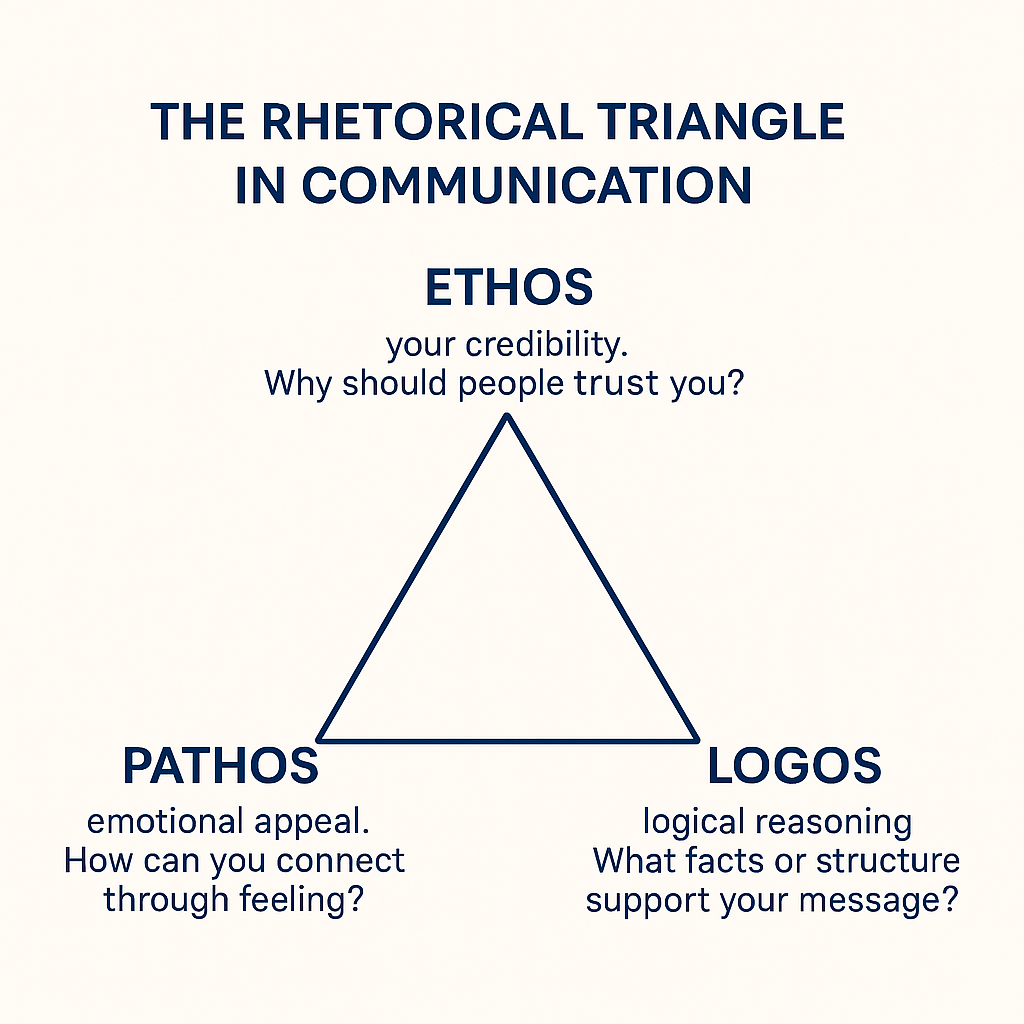
Every successful speech naturally dances between these three points. The best speakers build trust (ethos), evoke emotion (pathos), and deliver reasoned clarity (logos). When all three align, confidence flows, because you know your message stands on solid ground.
So, let’s recap and connect all the concepts we’ve touched until this point.
During every speech you will consciously or unconsciously use the Rhetorical Speaker’s Triangle to structure your message, the Hero’s Journey will help you deliver it, and you will use techniques to engage your audience through pauses, energetic bursts/peaks, facts, body language, etc.
All these elements tied together will give structure to your message, flow to your speech, engagement to your audience, and confidence to your body and mind!
10 Steps To Build Confidence In Public Speaking
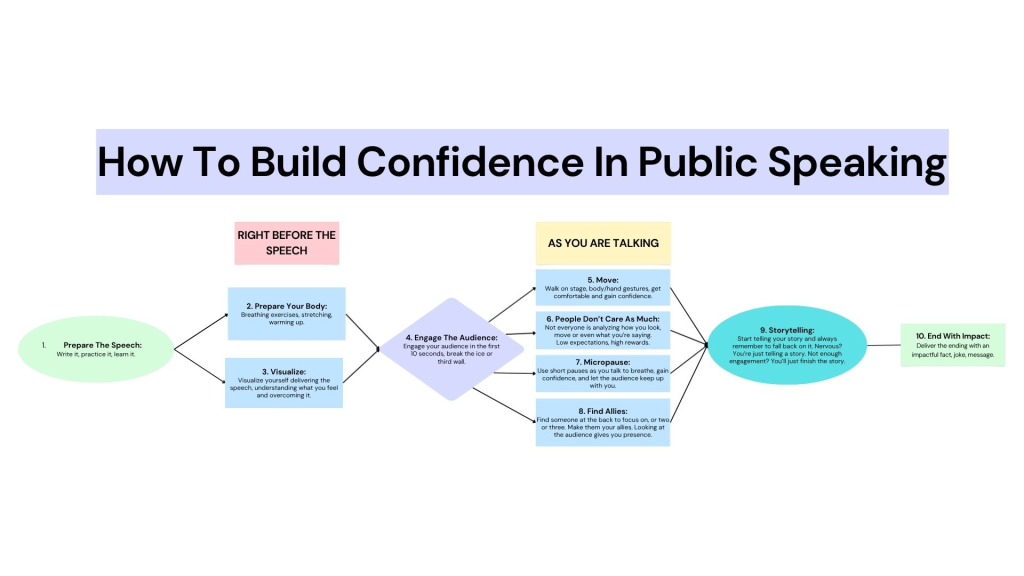
Finally, welcome to the 10-step framework to build confidence in public speaking. We’ve saved the best for last, and here are the ten steps or ten tips you should follow to make sure you feel confident, you have a strong ground on which to stand over to deliver your message.
1. Prepare Your Speech
Write, revise, and rehearse. Time yourself. Deliver it out loud until you can do it naturally without notes. If you’re well prepared, you’re likelier to succeed.
2. Prepare Your Body
Stretch your shoulders, neck, and legs. Loosen your jaw and warm up your voice. A relaxed body equals a relaxed mind. Lose the tension by using the exercises explained above.
3. Visualize Success
See yourself delivering the speech over and over again. See yourself at the podium, imagine the feelings you’ll have, and imagine yourself overcoming them. Embrace those feelings, beat them. Got nervous? Say to the audience you’re nervous and come up with a silly joke. Visualizing will prepare you.
4. Engage Immediately
Break the ice or “third wall” (that’s a literature concept where the narrator speaks to the reader), break the wall to get comfortable, gain confidence, and engage everyone.
5. Move
Don’t freeze. Walk naturally, gesture freely. Movement releases tension and adds energy to your delivery.
6. Remember: Nobody’s Really Judging You
The audience isn’t analyzing your every word. Most people want you to succeed, or they’re just thinking about lunch. Relax, it’s not that serious. Put yourself in their position: are you always paying attention to speakers? Are you really analyzing them that deeply? Probably not. You don’t matter as much to them, neither is your speech. Which makes it easier for you to: win them over. Little to lose, a lot to gain. A good speech will engage them, create an impact. A bad speech will be forgotten and who cares, it’s practice.
7. Use Micro-Pauses
Stop for 1-2 seconds, this lets the audience follow your narration. PLUS, it will help you breathe and make you present in the moment. Don’t be afraid of using micro pauses throughout the entire speech.
8. Find Allies In The Audience
Some say, “don’t look at anyone”. I recommend locking I need eyes with someone at the far back. Even if they’re not paying attention, look at their face. Turn them into an ally. Then look to your right, find a second one, etc. Avoid looking at those closer to you as you might get nervous, plus from an audience perspective it seems as if you’re “ignoring” those at the back. It’s easier to find an ally further back, also because you won’t be able to analyze their expressions.
9. Lean On Your Story
You can always fall back on your story. What does that mean? It means that maybe the audience won’t laugh if it was supposed to be humorous, maybe some aren’t paying attention, maybe you’re panicking and freezing. Well, it doesn’t matter, you just keep on telling the story, at the end of the day, it’s just a story, and if you know it, you keep on telling it.
10. End With Impact
Leave your audience with something to remember — a joke, a quote, a powerful fact, or a visual takeaway. The last part of your message is what most people remember.
So, How to Speak in Public With Confidence?
Confidence in public speaking doesn’t come from perfection, it comes from preparation, presence, and purpose. When you’ve practiced your message, relaxed your body, and learned to connect authentically with your audience, nervousness transforms into energy. You stop performing and start sharing. You tell your story with passion and emotion, and the audience will react to that. Speak with conviction, use pauses wisely, tell stories that matter, and remember: your goal isn’t to impress, it’s to connect. Confidence follows when communication becomes conversation.